
What Is Solar Panel Installation?
Solar panel installation is the design and fitting of a photovoltaic (PV) system that turns daylight into electricity for your home. A typical domestic job covers the panels and their roof mounting, the DC cabling down to an inverter, AC isolators, a generation meter, connection into the consumer unit and the paperwork that registers the system with your network operator and the Microgeneration Certification Scheme (MCS).
Many domestic designs use roughly 8 to 16 panels, but there is no standard size for every roof. A useful design starts with your roof layout and your pattern of electricity use. Compare expected bill savings with any export income using the actual tariffs available to you, rather than assuming one is always better.
Signs Solar Panels Could Suit Your Home
- A roof slope facing somewhere between south-east and south-west, or an east–west pair of slopes
- Little shading from chimneys, dormers, trees or neighbouring buildings between mid-morning and mid-afternoon
- Annual electricity use above about 2,500kWh, or plans for an electric car or heat pump that will push it higher
- Someone at home during the day, or willingness to add a battery or diverter to use more of the generation
- A roof in good condition that will not need recovering in the next ten to fifteen years
North-facing roofs are not automatically ruled out, but they generate noticeably less and usually need a closer look at the numbers before going ahead.
Solar Panel Installation Options Explained
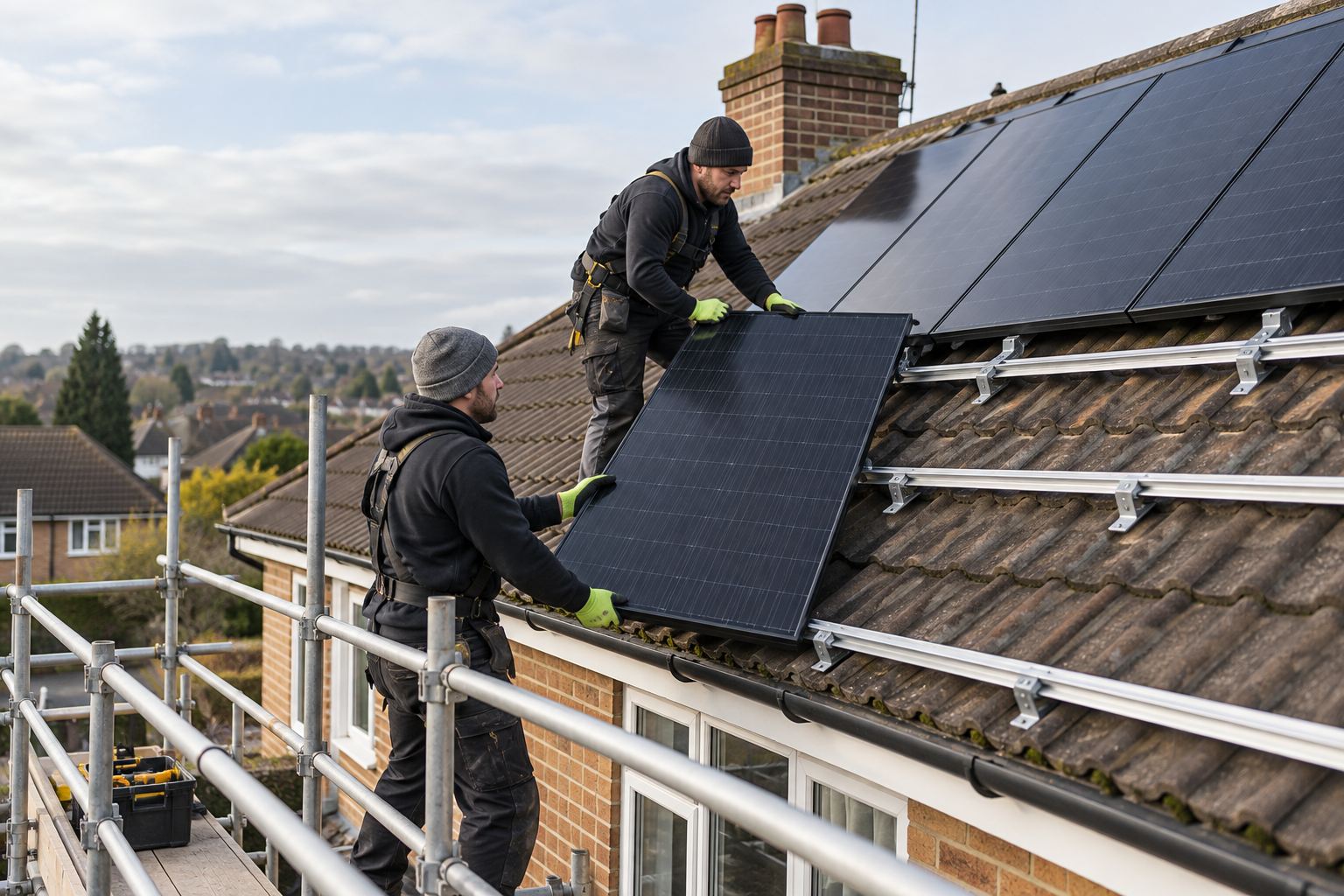
- On-roof (bolt-on) panels — the most common approach. Stainless roof hooks are fixed to the rafters beneath lifted tiles or slates, aluminium rails are attached to the hooks and the panels clamp onto the rails. It suits almost any pitched roof and is the cheapest to install.
- In-roof (integrated) panels — the panels replace a section of tiles and sit flush with the roof line inside a waterproof tray. They are often chosen for new builds, re-roofs and properties where appearance matters, and usually cost more.
- Flat roof and ground mounts — ballasted or fixed frames angle panels towards the sun on a flat roof, garage, outbuilding or in the garden. Ground mounts avoid roof work altogether but need space and a trench for the cable run back to the house.
The inverter choice matters as much as the mounting. A single string inverter is simple and economical on an unshaded roof; microinverters or optimisers handle partial shading and split roof faces better; and a hybrid inverter is worth considering if you may add a battery later.
What to Include When Asking for a Quote
Start with your annual electricity use in kWh, taken from a year of bills or your supplier's app, and mention any upcoming change such as an electric car, heat pump or home office. That figure is what the installer should use to size the array, so without it you are likely to be quoted a standard package rather than a system designed for your household.
Describe the roof as precisely as you can: which way each usable slope faces, whether the covering is natural slate, plain clay tile or concrete interlocking tile, and anything that throws a shadow across it during the day. Photos of the roof from the garden and the street, plus a photo of the consumer unit and electricity meter, let installers spot problems like an old fuse board or a long cable route before they visit.
A proper quote should list the exact panel, inverter and mounting products, the number and wattage of panels, and an MCS-based estimate of annual generation with the shading factor shown. It should also say whether scaffolding, bird protection, isolators, network operator notification and the MCS certificate are included, and set out the product warranties separately from the installer's workmanship guarantee.
How Much Does Solar Panel Installation Cost?
| System size | Typical cost |
|---|---|
| Small system, about 3kW (8 panels) | £4,500 – £6,000 |
| Mid-size system, about 4–5kW (10–12 panels) | £6,000 – £8,500 |
| Large system, 6kW+ or split roof faces | £8,500 – £11,000+ |
These figures cover panels, inverter, mounting, scaffolding and installation, and assume the 0% VAT rate that currently applies to domestic solar installations. In-roof systems, microinverters, extra electrical work and adding a battery at the same time will all push the price up.
The Solar Panel Installation Process: What to Expect
- Survey and design. The installer checks the roof structure, measures the usable area, assesses shading and looks at the consumer unit and cable route, then produces a layout and generation estimate.
- Network operator notification. Smaller systems are notified to the local distribution network operator (DNO) after installation under G98; larger ones need approval under G99 before connection.
- Scaffolding. Scaffolding usually goes up a day or two before the installation and stays until the array is finished.
- Roof work. Tiles or slates are lifted, roof hooks are fixed to the rafters, rails are fitted and the panels are mounted and wired.
- Electrical connection. The inverter, isolators and generation meter are installed and connected into the consumer unit, then the system is tested and commissioned.
- Handover. You receive the MCS certificate, electrical installation certificate, warranties and monitoring app details, which may be needed for export tariff applications in Great Britain.
Do I Need Planning Permission for Solar Panels?
In England, panels on the roof of a house are usually permitted development, provided they do not project more than 200mm from the roof slope and do not sit higher than the highest part of the roof, excluding the chimney. Listed buildings need listed building consent, and extra restrictions can apply in conservation areas and for ground-mounted or flat-roof arrays. Rules are similar but not identical in Wales, Scotland and Northern Ireland, so check the Planning Portal guidance or your local planning authority if you are unsure.
Building standards still apply. The roof must be able to take the extra load, and electrical work must meet the requirements in the relevant UK nation. In England and Wales, notifiable domestic electrical work can be certified through a competent person scheme or building control.
How to Choose a Solar Panel Installer
- Is the company MCS-certified for solar PV, and which consumer code does it belong to?
- Will someone survey the roof in person, or is the design based only on satellite imagery?
- Which panels and inverter are specified, and why are they suited to this roof?
- How was the generation estimate calculated, and what shading factor was used?
- Is the deposit protected, and is the workmanship warranty insurance-backed?
- Who handles the DNO notification, and when will you receive the MCS certificate?
You can check an installer's certification on the MCS website before signing anything.
Frequently Asked Questions
How many solar panels does a typical UK home need?
Most homes install between 8 and 16 panels, giving roughly 3.5kW to 6kW. The best size depends on your annual electricity use, the usable roof area and whether you plan to add a battery, electric car or heat pump.
Do solar panels work on cloudy days?
Yes, but at a lower output. Panels generate from daylight rather than direct sunshine, so they keep producing under cloud, although output in winter can be a fraction of a bright summer day.
How long do solar panels last?
Good-quality panels usually carry performance warranties of 25 years or more and often keep working beyond that with gradually reduced output. Inverters typically need replacing after around 10 to 15 years.
How much does solar panel installation cost?
Most UK domestic installations cost between £4,500 and £11,000, depending on system size, equipment, roof type and access. A survey is needed for a fixed price.