
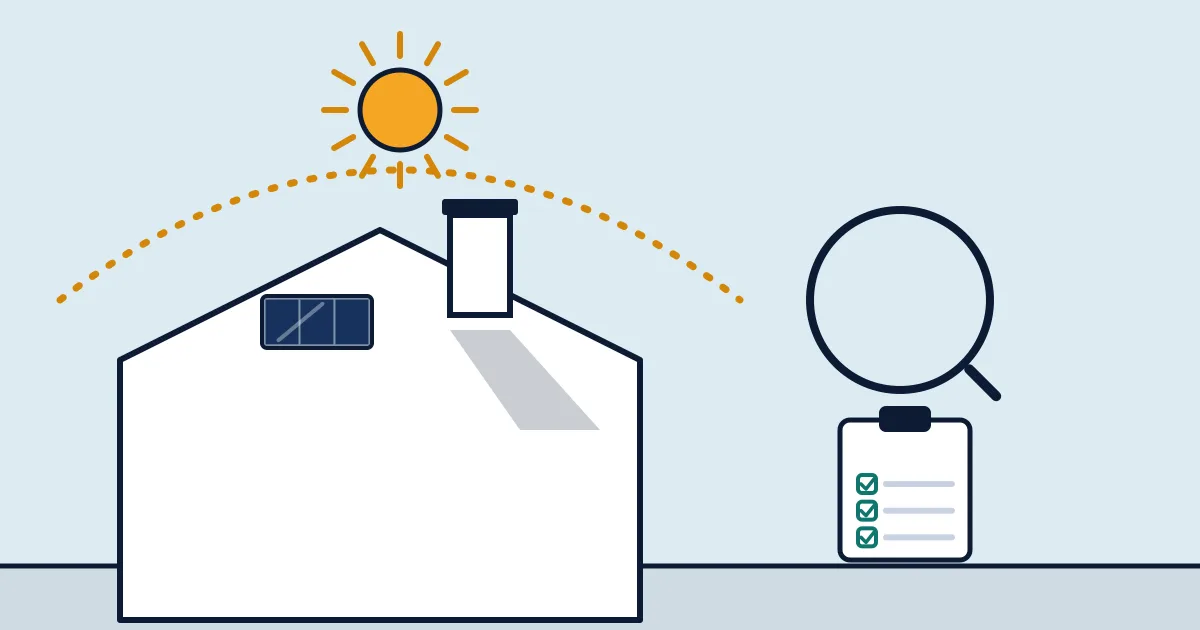
Most UK houses can take solar panels, but some roofs are much better than others. The roof that suits solar best faces somewhere between south-east and south-west, has little shade between mid-morning and mid-afternoon and is in good condition. Anything less than ideal does not rule solar out, it only changes the numbers. This guide walks through the checks an installer will make, so you can do a rough version yourself before asking for quotes.
What makes a roof good for solar
- Orientation. A slope facing south-east to south-west generates the most across the day. An east–west pair spreads generation into the morning and evening.
- Shading. Chimneys, dormers, trees and neighbouring buildings that throw shadow across the panels between mid-morning and mid-afternoon cut output, often for the whole string.
- Roof condition. If the roof will need recovering in the next ten to fifteen years, deal with that first, because panels have to come off and go back on.
- Usable area. Most homes fit 8 to 16 panels, roughly 3.5kW to 6kW, but vents, skylights and roof edges all take space.
- Structure. The rafters must carry the extra load, which an installer will check on survey.
- Your electricity use. A household using above about 2,500kWh a year, or planning an electric car or heat pump, gets more from a larger system.
How to check your roof in six steps
- Find which way each roof slope faces, using a compass app on your phone or a map. Note every slope you could use.
- Look at the roof at different times of day, or in photos, for shadows from chimneys, trees, dormers and neighbouring houses.
- Check the covering. Note whether it is natural slate, plain clay tile or concrete interlocking tile, and look for slipped, cracked or mossy tiles.
- Estimate how much clear area there is, avoiding vents, skylights and the edges of the roof.
- Find out how old the roof is and whether it will need work soon. If you are unsure, a roofer can inspect it.
- Gather a year of electricity bills or your supplier's app data, and a photo of your consumer unit and meter, to give installers.
What if my roof is not perfect?
Common roof situations and how installers usually handle them
| Roof situation | What it means for solar |
|---|---|
| East–west pitched roof | Generation is spread across the day. Often a good fit for households that use power morning and evening. |
| North-facing slope only | Output is noticeably lower, so the numbers need closer scrutiny before going ahead. A ground mount or outbuilding may serve better. |
| Partial shade from a chimney or tree | Microinverters or optimisers can limit the loss. Panels can sometimes be placed to avoid the shadow instead. |
| Flat roof | Frames tilt the panels towards the sun. Weight, drainage and the waterproof layer matter. |
| Small or complex roof | A smaller array, or in-roof panels, may suit better. A survey will say. |
| Listed building or conservation area | Extra rules apply and planning permission may be needed. Check before designing. |
If your roof needs recovering, speak to a roofer before a solar installer. Our Solar Panel Installation page covers how a survey works, and the installation cost guide shows what a system typically costs once you know your roof is suitable. Where shading or split roof faces are the problem, solar PV upgrades such as optimisers may be part of the answer.
In England, panels on a house roof are usually permitted development, but listed buildings, conservation areas and flat roofs have conditions, and the rules in Wales, Scotland and Northern Ireland differ. The rules were updated in England in August 2026, so check the Planning Portal or your local planning authority before you commit.
How to check whether your roof suits solar panels
- Find the direction of each roof slope
Use a compass app or a map to note which way every usable slope faces.
- Look for shade
Check for chimneys, dormers, trees and neighbouring buildings casting shadow between mid-morning and mid-afternoon.
- Check the roof covering
Note whether it is slate, clay tile or concrete tile, and look for slipped, cracked or mossy tiles.
- Estimate the usable area
Allow for vents, skylights and roof edges, and note the space left for panels.
- Consider the age of the roof
Find out whether it will need work in the next ten to fifteen years and get it inspected if unsure.
- Gather your electricity data
Collect twelve months of electricity use in kWh and photos of your consumer unit and meter for installers.
Frequently asked questions
Can I put solar panels on a north-facing roof?
You can, but output is noticeably lower, so installers will look closely at the numbers. A south, east or west slope, an outbuilding or a ground mount may be a better place.
Does shade from a tree ruin solar panels?
Shade lowers output, and on a single string even a small shadow can drag down the whole row. Microinverters or optimisers can reduce the effect. An installer's shading estimate will show how much.
Do I need a new roof before installing solar?
Not necessarily. Roofs that are in good condition and have a fair amount of life left are fine. If the covering is near the end of its life, do the work first, because panels must be lifted off to re-roof.
How many solar panels can my roof take?
Most homes fit 8 to 16 panels, giving roughly 3.5kW to 6kW. The actual number depends on usable area, orientation and whether you want to leave space for later additions.
Ready to talk to a solar panel installation specialist?
Get Free Quotes →